Circle Stock Doubles in a Month: What's Really Driving the USDC Rally in 2026
Date: 2026-03-16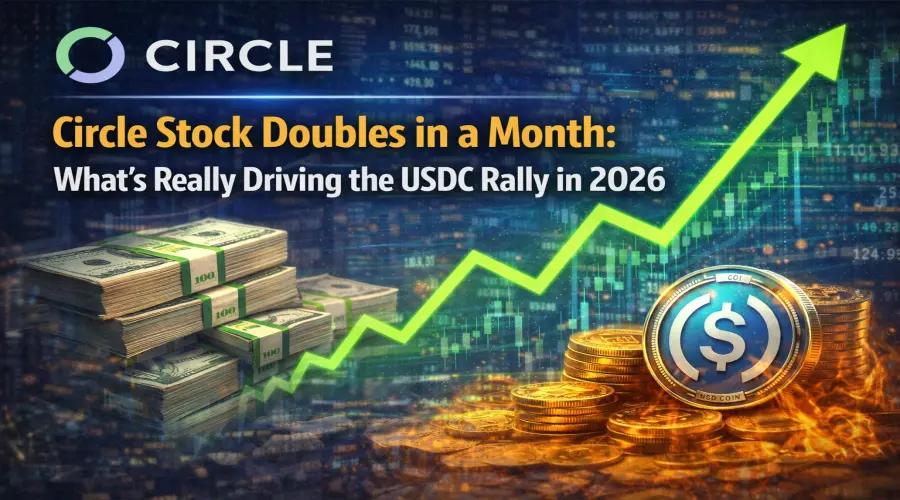
When most people think of stablecoins, they think of stability — boring by design, predictable by nature. Yet Circle, the company behind the USDC stablecoin, has quietly become the most talked-about trade in digital assets over the past four weeks. Shares of Circle (CRCL) have gained more than 100% since mid-February, outrunning nearly every other crypto-adjacent equity in the market.
On Monday alone, the stock added another 8%, closing around $124. To put that in perspective, Strategy (MSTR) — the Bitcoin treasury company helmed by Michael Saylor — is up roughly 23% over the same period, while Coinbase (COIN) has added around 8.5%. Circle, in other words, isn't just keeping pace. It's lapping the field.
So what exactly changed?
Analysts Are Coming Around — Fast
The analyst community has done a notable U-turn on Circle in recent months. Clear Street upgraded the stock to Buy and raised its price target to $136, up from $92. Mizuho followed suit, lifting its target to $120. Even Compass Point's Ed Engel, who was arguably Circle's most vocal skeptic on Wall Street, threw in the towel in January and moved his rating from Sell to Neutral. The most bullish voice right now is Seaport Global, which is carrying a $280 price target on the name.
The common thread across these upgrades isn't hype — it's a reassessment of USDC's structural role in the financial system and what that means for Circle's bottom line.
Interest Rates Are Working in Circle's Favor
Here's the part that doesn't get enough attention: Circle makes money the old-fashioned way. A significant share of its revenue comes from interest earned on the dollar reserves that back USDC. The higher interest rates are, the more Circle earns — full stop.
Right now, geopolitical pressure from rising tensions in the Middle East and climbing oil prices is reinforcing a "higher for longer" narrative around Federal Reserve policy. Sticky inflation means rate cuts get delayed. Delayed rate cuts mean Circle's reserve income stays elevated longer than previously expected. It's a macro tailwind that's operating largely in the background but quietly underpins the bull case.
USDC Holds Its Ground While Crypto Tumbles
The broader crypto market has had a rough stretch. Total market capitalization has fallen roughly 44% since October 2025. Yet USDC's market cap has remained relatively stable throughout — a fact that underscores a key distinction: USDC isn't a speculative asset. It's infrastructure.
Traders, institutions, and protocols use USDC to settle trades, post collateral, and move dollars across borders without touching the traditional banking system. That demand doesn't evaporate when Bitcoin drops 30%. If anything, market volatility often pushes more activity toward dollar-denominated stablecoins as participants seek safe harbor.
Tokenization Is Becoming a Real Revenue Driver
One of the more compelling structural arguments for Circle centers on the tokenized asset market. The process of bringing real-world financial instruments — Treasuries, money market funds, corporate credit — onto blockchain networks has been accelerating. Many of these products depend on USDC for subscriptions, redemptions, and day-to-day settlements.
According to analyst estimates from Clear Street, the tokenized asset market has expanded from approximately $1.5 billion in early 2023 to around $26.5 billion today. That growth trajectory is directly tied to rising on-chain dollar demand, and USDC sits at the center of much of that activity. BlackRock's tokenized Treasury fund, BUIDL, alone crossed $2 billion in assets and has relied on USDC as part of its operational infrastructure.
Prediction Markets and AI Payments Are Adding Fuel
Two newer use cases are catching Wall Street's attention. Prediction markets — led by platforms like Polymarket — processed more than $22 billion in trading volume during 2025, with USDC as the dominant settlement currency. That's not a niche experiment anymore; it's a measurable demand source.
Then there's artificial intelligence. Autonomous software agents increasingly need to make payments — purchasing data feeds, compute resources, APIs — and they need to do it programmatically. Early data suggests that roughly 98% of AI agent-to-agent payments are settled in USDC. As agentic systems become more embedded in commercial infrastructure, the stablecoin layer they depend on becomes more valuable. Circle is currently positioned as the default choice.
Regulation Could Be the Catalyst That Unlocks Institutional Scale
Regulatory clarity remains one of the biggest unlocks for the stablecoin sector. The CLARITY Act, which aims to establish a coherent legal framework for digital assets in the United States, has gained visible political support — including a public endorsement from President Trump. Analysts note that a functioning regulatory structure would remove a major barrier to institutional adoption, potentially expanding the addressable market for USDC significantly.
Clear Street's analysts summed it up plainly: the market has likely underestimated how much tokenization, prediction markets, geopolitical volatility, and AI-driven payments will ultimately affect USDC volume. That volume translates directly into Circle's business.
For now, Circle's story is a reminder that the most durable trades in crypto aren't always the flashiest ones. Sometimes they're built on infrastructure that was already there — waiting for the world to catch up.
For businesses looking to build or expand in the digital asset space, having the right technology foundation matters as much as market timing. ATNM Digital Solutions offers a suite of white-label SaaS and B2B products designed for online businesses operating in fintech, crypto, and adjacent markets — from prop trading platforms to fully branded client portals. Whether you're scaling an existing operation or launching something new, their infrastructure solutions are worth a look: https://atnm-digital.com