SEC Chair Paul Atkins Faces Congressional Scrutiny Over Crypto Enforcement Reversal and Justin Sun Investigation
Date: 2026-02-12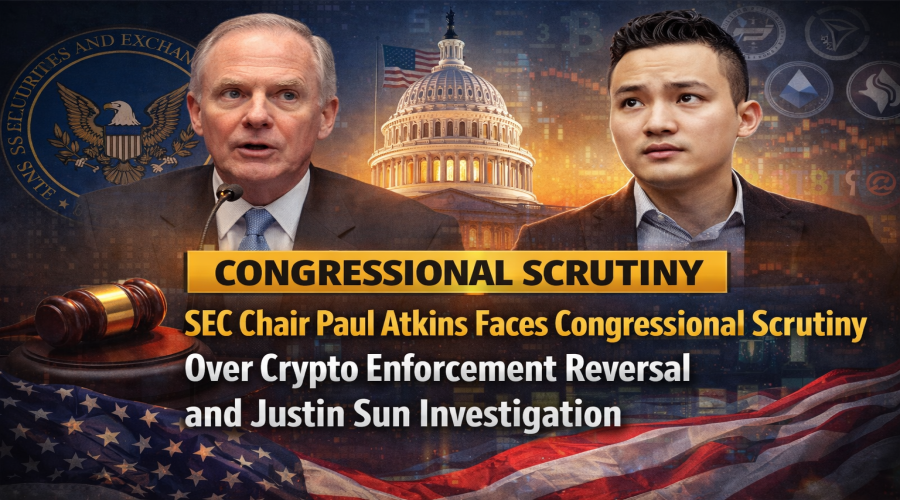
Securities and Exchange Commission Chairman Paul Atkins faced intense questioning from House Financial Services Committee members on Wednesday regarding the agency's abrupt withdrawal from cryptocurrency enforcement actions, with particular focus on the stalled investigation into Tron Foundation founder Justin Sun.
During the oversight hearing, Representative Maxine Waters, the committee's top Democrat, pressed Atkins to explain why the SEC has abandoned nearly every crypto-related enforcement matter initiated under previous leadership. Waters specifically highlighted the agency's pause in proceedings against Sun, whose case involves allegations of securities violations, market manipulation, and fraudulent token promotion.
The SEC's original complaint against Sun, filed in 2023, accused him and his organization of orchestrating an unregistered securities offering while artificially inflating trading activity for TRX tokens. Investigators alleged that Sun directed employees to conduct hundreds of thousands of wash trades—fake transactions designed to create the illusion of market demand—across trading platforms he controlled.
"Chairman Atkins, you've stated that under your leadership, the SEC will focus on real fraud," Waters said during the hearing. "Does that commitment extend to fraud in the cryptocurrency markets?"
Atkins responded that the agency would pursue cases involving securities but declined to discuss specific enforcement actions. He offered to provide lawmakers with a confidential briefing on the matter, noting legal constraints on public commentary about ongoing investigations.
The Justin Sun case has drawn particular attention because, unlike enforcement actions against major exchanges like Binance, Coinbase, and Kraken—which the SEC has formally dismissed—the proceedings against the Tron founder remain technically active but paused. The agency requested a court stay in February 2025 to explore settlement possibilities, and that suspension has now extended for nearly a year.
Democratic lawmakers raised concerns about potential conflicts of interest, pointing to Sun's substantial investments in Trump-affiliated cryptocurrency ventures. According to congressional records, Sun committed over $75 million to projects including World Liberty Financial shortly before the SEC sought to pause its enforcement action against him.
When asked by another committee member whether the SEC would pursue enforcement even when it might affect businesses connected to President Trump, Atkins deflected. "As far as what the Trump family does or not, I can't speak to that," he stated.
The hearing revealed a stark partisan divide. While Democrats focused on what they characterized as selective enforcement and erosion of investor protection, Republicans concentrated on Atkins' plans to establish clear regulatory frameworks for the cryptocurrency industry.
Atkins told the committee that the SEC is developing rules in coordination with the Commodity Futures Trading Commission that would align with the Clarity Act—legislation passed by the House to delineate jurisdictional boundaries between the two agencies. Although the bill's fate in the Senate remains uncertain, Atkins expressed confidence that joint regulatory guidance would provide the certainty digital asset companies have long sought.
"We're working on rules consistent with what's in the Clarity Act that you passed here in the House," Atkins explained. "This will help give certainty as to where the jurisdiction of the two agencies are."
Under the Project Crypto initiative, the SEC and CFTC have accelerated efforts to create a unified regulatory approach. The CFTC recently updated guidance to clarify that national trust banks can issue payment stablecoins, expanding the range of institutions eligible to participate in the tokenized collateral ecosystem.
Since January 2025, the SEC has dismissed or withdrawn from more than a dozen cryptocurrency enforcement actions, including several cases where courts had already ruled in the agency's favor on key legal questions. The regulatory reversal has coincided with a period of significant political spending by cryptocurrency firms, with industry players contributing tens of millions to Trump's reelection campaign and inauguration events.
Representatives Waters, Brad Sherman, and Sean Casten have formally requested that the SEC preserve all internal communications related to the decision to pause the Sun litigation, including any contacts with external parties who may have attempted to influence the outcome.
The controversy underscores the broader debate over the SEC's role in cryptocurrency oversight. Critics argue that the agency's retreat from enforcement sends a troubling signal that well-connected individuals can evade accountability, while supporters contend that a clear regulatory framework will ultimately provide better protection for investors than enforcement actions based on ambiguous rules.
Neither Sun nor representatives from the Tron Foundation provided comment following the congressional hearing.
As the crypto industry awaits clearer regulatory guidance, the SEC's handling of the Sun case—and whether it will ultimately result in enforcement, settlement, or dismissal—may serve as a defining test of how the agency balances political pressures with its mandate to protect investors.
The outcome could set precedents affecting how the United States regulates cryptocurrency markets for years to come, particularly as digital assets become increasingly integrated into mainstream finance and political fundraising.