Bell Is Cutting Another 690 Jobs. The Restructuring That Never Seems to End
Date: 2026-06-16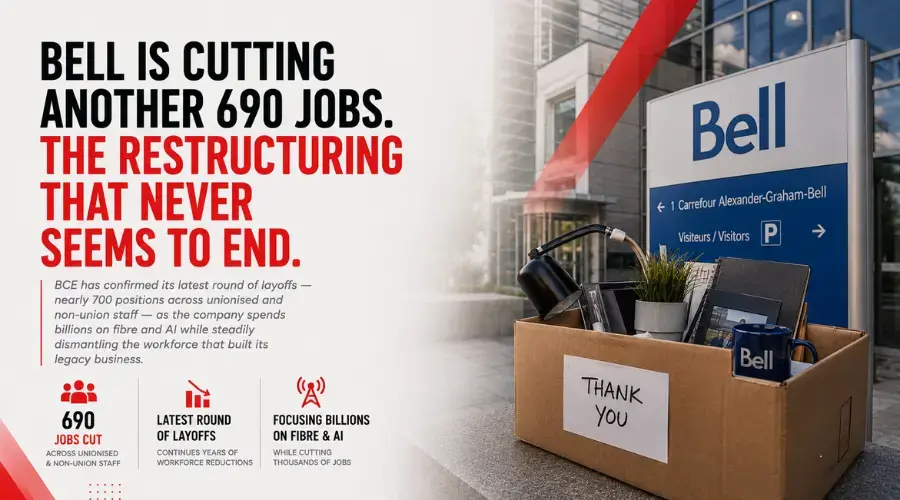
Bell Is Cutting Another 690 Jobs. The Restructuring That Never Seems to End.
BCE has confirmed its latest round of layoffs — nearly 700 positions across unionised and non-union staff — as the company spends billions on fibre and AI while steadily dismantling the workforce that built its legacy business.
Key Points
- BCE has confirmed the elimination of 690 positions — approximately 460 non-union employees laid off outright, and roughly 230 unionised roles targeted through voluntary departure packages. Bell Media is not affected by this round.
- The cuts continue a restructuring that began in October 2024, when BCE announced a target of $1.5 billion in total cost savings by 2028; since then, the company has eliminated well over 6,000 positions.
- Separately, BCE has dismissed a number of employees for alleged falsification of workplace attendance under its three-day in-office policy — firings being contested by more than 30 workers represented by Toronto employment lawyers who say management tacitly approved the same behaviour before using it as grounds for termination.
- The company simultaneously announced a $1.7 billion AI data centre project near Regina, projected to generate up to $12 billion in economic value — a juxtaposition that captures the contradictions at the heart of BCE's transformation strategy.
There is a particular exhaustion that sets in when a company's restructuring becomes a recurring news event rather than a discrete episode. BCE — the parent company of Bell Canada, Canada's largest telecommunications provider — confirmed on Sunday, June 15, that it is cutting another 690 jobs, continuing a reorganisation it formally announced in October 2024. The round brings another wave of affected employees into a process that has now been running for nearly two years, through multiple phases and thousands of departures, with no public indication of where it ends.
The breakdown this time is 460 non-union employees being laid off and approximately 230 unionised positions being wound down through voluntary separation packages — a structure designed to manage the labour relations complexity of cutting across both groups simultaneously. Bell Media, which has weathered its own cuts in prior rounds, is not part of this reduction. BCE confirmed the figures to CBC News, framing the move in language that has become familiar across all its public statements on restructuring: the cuts reflect ongoing operational changes, including the migration of customers to fibre networks and the pursuit of continued operating efficiencies.
"These changes are part of our ongoing business operations and reflect several initiatives, including the migration of customers to a more resilient, easier-to-maintain fibre network and ongoing operating efficiencies."
— BCE Inc., statement to CBC News, June 15, 2026The broader context requires some arithmetic. BCE had 38,683 employees at the end of 2025. The company cut approximately 4,800 positions in 2024, then 690 more in November 2025 — predominantly management roles — followed by 98 further cuts in February 2026, and now another 690. The cumulative toll since the restructuring began is well into the thousands, representing a meaningful compression of the company's total headcount even as its first-quarter 2026 operating revenues came in at $6.17 billion, up four per cent year-over-year. The revenue growth and the job losses are not contradictions in BCE's strategic logic — they are the point. The company has told investors it is building a leaner, more automated business, and the quarterly numbers suggest that framing is at least partially credible.
What makes this round harder to read cleanly is a parallel controversy unfolding alongside the formal layoffs. BCE has separately dismissed a group of employees — the precise number has not been disclosed — for what the company describes as deliberate and repeated falsification of workplace attendance records under its mandatory three-day in-office policy. The firings are categorised as for-cause terminations, which under Canadian employment law would typically eliminate the company's obligation to provide severance. That categorisation is now being aggressively contested. A Toronto employment lawyer told CBC News that he represents more than 30 workers disputing the characterisation, arguing that managers had effectively approved or tolerated the same attendance behaviour for months before it was retroactively used as grounds for termination. BCE flatly denies that account. The legal proceedings that follow will determine which version holds up.
The optics of the timing are complicated further by an announcement BCE made in March — that it is spending $1.7 billion to build a large-scale AI data centre near Regina, Saskatchewan, a project the company projects will generate up to $12 billion in economic value and support around 800 construction jobs. The investment is being cited as evidence that BCE is not simply contracting but transforming, redeploying capital from legacy headcount into infrastructure for the next phase of its business. Whether that argument lands with the employees receiving departure notices in June is a different question.
The pattern that has emerged across BCE's multi-year restructuring is one that reflects a broader tension running through the Canadian telecommunications sector. The country's major carriers are simultaneously under pressure from regulators to invest in network coverage, from investors to improve margins, from governments to maintain employment, and from a rapidly shifting technology landscape to automate functions that were once labour-intensive. Bell is navigating all of those pressures at once, and the job cuts are the most visible expression of where the balance is currently being struck.
For the workers involved in this round, the distinction between a managed restructuring and a company in distress may feel academic. For BCE's shareholders, who have watched the stock underperform for several years through dividend cuts and write-downs, the question is whether this level of operational compression is enough to make the investment case compelling again. The company says it is building toward sustainable growth. It has been saying some version of that for two years. The next few quarters will start to reveal whether the arithmetic actually works.